Saturday, August 11, 2012

Day 9: Shiloh


I was a little disappointed to find that our route to Shiloh took us through northern Mississippi, rather than across Tennessee, but it was at least a relatively short drive to the battlefield.
Visitors Center at Shiloh National Military Park
The visitor center and bookstore were separate, and the visitor center featured a small exhibit with a couple of neat features, including a set of reproduction Union and Confederate uniforms, child-sized, for kids to put on, and a mirror to look at themselves. The rest of the exhibits were fairly standard. The orientation video, however, was the best we've seen yet, flawlessly integrating first-person stories (as at Manassas) with big-picture quotes from generals and animated battlefield maps to pull the whole story together.
Kids' uniforms at Shiloh
It helps that Shiloh was a basic down-and-back; the Union arrived via riverboat fleet, began to spread out in the hopes of advancing on and seizing the railroad depot in Corinth, MS, and engaged with the Army of the Mississippi under Albert Sidney Johnston. Johnston's army engaged Grant before Grant's second wing had yet arrived, and pushed the Union troops back so effectively that at the end of the first day a message was sent back to Jefferson Davis announcing that the battle was a resounding victory.
Massed Confederate artillery pointed at Union positions within the Hornets Nest
Grant was reinforced by Buell overnight, and used his fresh men to smash the Confederate right, then reinforced his own right to smash the Confederate left, fighting back and regaining the same ground they'd lost the day before and sending the Confederates back to entrench around Corinth. Shiloh was the first battle where Grant began testing out his total war strategy, and was one of the bloodiest of the entire war – the first to really put horrific casualty numbers on newspaper front pages back east.
Shiloh Church, passed twice by the line of battle
The battlefield itself was quite good, and it was easy to pick out major points of engagement (Fraley's Field and the Hornet's Nest among them) and benefited – as did Antietam – from having a fairly simple trajectory over a fairly short period of time.
Fraley's Field, where the battle began at 5am
Looking out and down to Pittsburg Landing, where Union reinforcements under Buell arrived to turn the tide of battle on the second day.
After Shiloh, we pushed on east – through northern Alabama this time, still not through Tennessee – to camp at the foot of Lookout Mountain, on the Tennessee-Georgia border, just outside Chattanooga.

Friday, August 10, 2012

Day 8: Memphis


The next morning we drove up along the western border of Mississippi toward Tennessee to spend the afternoon and evening in Memphis before we began to venture east again. We did only a small amount of tourism in Memphis, seeing at least the outside of the relocated W.C. Handy House (closed and locked despite signs saying it should be open for tours), reading some historical markers on Beale St., and visiting the Cotton Museum.
The oddly-situated and sadly-closed W.C. Handy house.
The Cotton Museum was clearly new and very polished, with some really, really nice bits, and some slightly odd quirks that I will think about and discuss in a future more museum-centric post.
Interior of the Cotton Museum.
That evening we also did a bit of cultural tourism, if you want to call it that, by spending a few hours on Beale St. eating BBQ and taking in the atmosphere of live music and street performances on a Saturday night.
Beale St. on a Saturday Night
We did get in one final museum, and it was an absolute gem. The Schwab/Beale St. Museum is simply a landing area within the Schwab general store, which has been on Beale St. for nearly 150 years. Objects from the store's history were displayed charmingly though with no museum polish to speak of - which is far from a bad thing! There were easily a half-dozen people through the space just in the few minutes before closing.,..on a Saturday night, when bars up and down the street were open! I'll talk more about why I really, really liked this space in a future post.
Looking down from the third floor into th

Thursday, August 9, 2012

Day 7: Vicksburg


Our day started with an unexpected but nice detour to the Tuskegee Airmen National Historic Site in Tuskegee, Alabama. Sadly, we didn't realize that we'd switched to Central Time, so instead of a short wait for the museum to open, we had to satisfy ourselves with reading the (quite good) interpretive signage and appreciating the view.

Moton Field, training ground for the Tuskegee Airmen
We arrived in Vicksburg in good time, and began in the Visitors' Center with a decent overview film of the campaign and siege. For the first time, I felt a bit uncomfortable as a Northerner, and disagreed with some of the characterizations in the film. In particular, the film seemed to paint Grant's repeated bloody attempts to take the city as a last-ditch effort to save his career, and talked repeatedly about the bravery of the Confederate defenders.

We then set out on a driving tour of the battlefield area itself, using for the first time a cell phone tour that was really quite good. At our first stop, a Park Ranger was waiting for visitors and gave us a great overview of the field from where we were standing. He explained that the unique qualities of the soil in the area made the incredible terrain features that we were seeing, and also made it a highly defensible position for the troops at Vicksburg. He also added quite a few things to our cell phone tour about the artillery tactics of both sides.

Our very patient and helpful Ranger pointing out a Confederate position across the way.
The tour itself took us about two hours, and was really quite fun. It was well laid-out in that it took us first along the line of Union emplacements, then along the Confederate line, so we were able to see the vantage points from both sides and appreciate how the ground made such a huge difference.

The Vicksburg National Military Park has recently embarked on a series of clear-cutting projects to make that ground even more obvious. During the siege, the vegetation would have been stripped bare; as the audio tour explained to us, the forest covering the hills was planted by the Civilian Conservation Corps, believing that it would help keep the land from eroding. Since then, the Park Service has discovered that grass is a more effective vegetation to keep the soil in place. In the first area of the battlefield, the clear-cutting was mostly complete, and it made a huge difference. In the second area, the project was still underway, and it was immediately obvious how much better it made the view and interpretation of the battlefield.

The results of the recent landscape preservation/clear-cutting.
Cutting back vegetation in some cases also revealed the remnants of the tunnels and earthworks dug out by Union soldiers as they made their way through the lines. The last bit of the tour included some remarkably well preserved remnants, such that from a certain vantage point you could see the zigzag of the tunnel as it approached the Confederate lines. Soldiers dug them in those meandering patterns to confuse Confederate sharpshooters.

Zigzag remnants of earthworks.
The last piece of the Vicksburg park (or rather, midway through the tour, but last thematically) was the restored USS Cairo, which is apparently pronounced like the city in Illinois, not like the city in Egypt. The ship itself, her timbers, and her conserved metal portions, was outside under a huge tent, and alongside the ship was a small museum with artifacts salvaged from the Mississippi. The Cairo was sunk even before the siege properly started, and her crew evacuated to land with several of their guns and proceeded to set up shop as if they were still on the ship while taking their place in the Union artillery line. Apparently they cleaned off the emplacements each day as if they were swabbing the deck, kept to the bells system of timing, and were a great source of amusement for the regular army men.

The USS Cairo and her museum.
That night, we visited the other side of Vicksburg. After the Mississippi river shifted its course in a flood after the war, Vicksburg lost most of its economic prosperity. In recent years, it has turned to legalized gambling to alleviate some of its poverty. Casinos, not history, are now Vicksburg's main draw. I had never actually visited a casino until we visited the Ameristar, and likely will not repeat the experience. It mostly struck me as sad, rather than exciting, and left me wishing that there were some way to make history and cultural tourism fill up the gap, rather than gambling.
Ameristar Casino in Vicksburg

Monday, August 6, 2012

Day 6: Andersonville


I read Mackinlay Kantor's novel Andersonville some months ago, and it has really stayed with me, so when we were planning this trip, I made sure the Andersonville National Historic Park was a stop. We arrived in early afternoon, with plenty of time to see an introductory video to the prison that was a little rough around the edges but whose overall impression was eerie and heartbreaking. The room was completely silent and no one moved from their seats for at lest a minute after it ended.
Entrance to the Andersonville Visitors Center / National Prisoner of War Museum
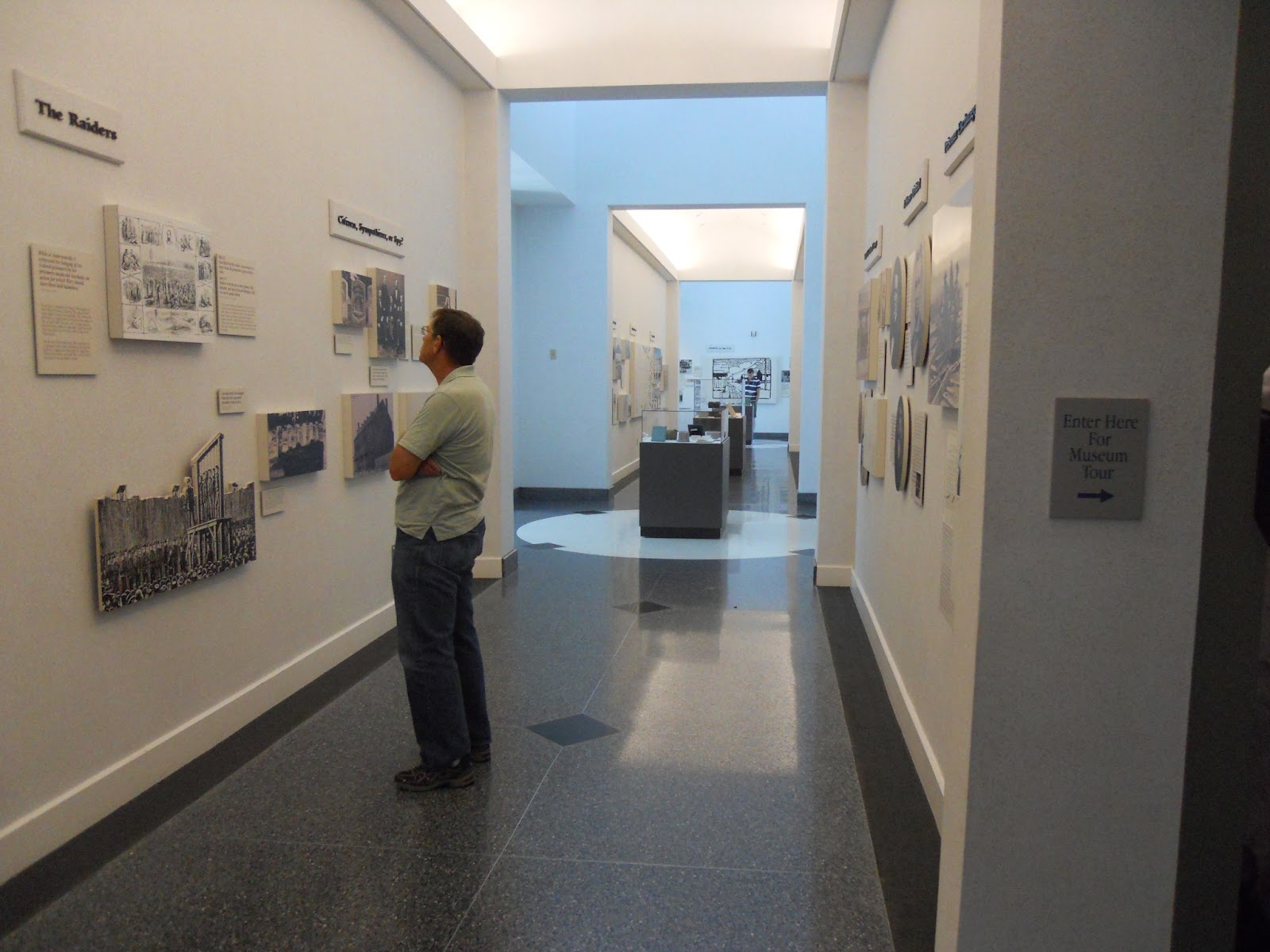
We then walked through the National Prisoner of War Museum, which had some really extraordinary strengths – some deeply thoughtful exhibit text and installations, and amazing artifacts, but also had some really terrible weaknesses, such as obvious typos and poor overall organization. The long central hallway, for example, told the story of the Civil War and of Andersonville simultaneously (not really chronologically) but had exhibit cases in its center with objects from the Bataan Death March...with no cohesive text that I could see.
Civil War text and photographs on the wall; World War II artifacts in the center.
Other installations in the museum did a remarkable job of explaining the psychological toll of being a prisoner of war, as well as the fraught international status of many prisoners, emphasizing that not all POWs were the same. There were a few disturbing exhibits, such as reproductions of cells and “tiger cages” from Vietnam, and some interviews with former POWs that brought tears to my eyes.
Nicely done interpretive section explaining the complexities of international law as it applies to prisoners of war by using examples from American history.
Once we finished with the museum, we checked out an audio tour at the desk for free (score one over Gettysburg!) and drove around the site of the prison itself. The park itself was masterfully done: informative without being overwhelming, with occasional tasteful reproductions that did not take away from the overall scope and impact of the land. The audio tour had good wayfinding (telling us that it was timed for 10mph, for example, and suggesting spots where we would benefit from getting out and exploring).
Overall view of the site, taken standing at the southern end of the prison.
I was blown away by several things. First, how small the overall space was. I couldn't quite picture the limits of the stockade, but the walls were shown by white poles every twenty feet or so that clearly outlined the space without being too obtrusive. There was an outer line of poles for the stockade wall, and an inner line for the deadline, and it was eerie to stand between them.
Stockade wall on the left, deadline on the right; really only 15 feet or so between them.
The two reproduced sections of stockade wall and gate were good to get a taste of just what the walls looked like. I would never have expected, for example, for the footing of the logs to be so splashed with red Georgia clay, making them seem almost bloody. I also hadn't expected so much terrain – I must have missed references to that until now. Standing on a bit of a rise, we could look down and see clearly how much land must have been unusable because of the marshy area around the Stockade Branch - and how quickly that must have become a cesspool.
View from the North Gate reproduction, with the marshy area of the Stockade Branch visible in the center.
Reproduced prisoners' shebangs and stockade wall in one corner.
We left via the Andersonville National Cemetery, which was quiet and still and desperately sad. I've been to military cemeteries before, and many of them have an air of quiet sacrifice and, if nothing else, accomplishment and pride. This had none of that. There are no good deaths in war, but there can be quick and clean deaths; none of these were.
Prisoners' graves at Andersonville National Cemetery.

Sunday, August 5, 2012

Day 5: Fort Sumter and Charleston


We left North Carolina a bit later than we should have, and as such were keeping an eye on the clock to make sure we could catch the last ferry out to Fort Sumter, which left from the Patriots Point Maritime Museum. I would've loved to spend more time at that museum, as it housed the USS Yorktown, a beautiful World War II aircraft carrier, but alas, we only stared longingly at it from port while we waited for the ferry.
The USS Yorktown, at dock in the Cooper River, as seen from the ferry.
The ferry boat itself was surprisingly packed with people heading out to Fort Sumter, and there was historical narration that told us about the history of Charleston, pointing out things to see to the left and to the right. When it came time to learn about Fort Sumter – at least the post-Civil War part – every passenger's concentration was completely lost when a pod of dolphins began to play in the wake of the ferry.
Fort Sumter on the approach.
Our perfect weather record broke just as the ferry came in to dock and the skies opened up. They hurried us in to the walls of the fort for a safety talk – no climbing on things or sticking arms down the cannons – and then turned us loose. The rain was coming down in absolute buckets, and in our short sprint across the courtyard to the museum space we got quite wet.
The view out the harbor during one of the few lighter moments of the storm.
The museum was decent, not great, and quite outdated. It had some extraordinary artifacts, however, including the palmetto flag that was flown over Sumter after it was taken by the Confederacy, and Major Anderson's United States flag, the same one he lowered after surrendering and raised again when the war was over. There was an attempt to explain the fort's history after the Civil War, which included a deeply confusing video that looked more like an installation than anything informative; we watched a few minutes of a World War II-garbed soldier looking sulky and pensive as he wandered up and down the beaches near what I believe was Fort Moultrie. No sound – not even background noise – and no captioning.
Anderson's flag that was lowered when Fort Sumter surrendered, and then raised again at the end of the war.
The rain didn't really ever let up, but it did ease from time to time, enough for us to poke around the other areas of the fort. There wasn't much there, and the Spanish-American War era battery standing squat across the old parade ground did not help. It was interesting overall, but not a highlight.
Inside the fort walls - really the only bit you could do much walking around in. Even that started to flood!
A good view of the Huger Battery, an ugly black squat building. You can also see how the water had started to pool in the courtyard just from our storm.
That night, we wandered about Charleston a bit, which was a charming city, with friendly people. I'm always interested when I visit a new region and see clear and distinct architecture – and Charleston definitely had that, with its stately houses that looked, to my eye, to be turned sideways. The next morning, we drove around Battery Park and saw the beautiful mansions there.
Museum of the Confederacy, definitely on my list for the next time I visit - already closed by the time we made it to downtown.
A very pretty example of the "sideways" style of houses - note that the door leads to the porch, not directly into the house. I'll have to find a good history of Charleston to learn more about this.
Charleston City Market
Battery mansion

Saturday, August 4, 2012

Day 4: Camp Lejeune


Our next day was a respite day, which involved no museum or historic visits at all. We did, however, spend the day in a place deeply steeped in tradition, as we toured Camp Lejeune with a friend who is a Marine officer and ate at the Officer's Club on base.

The Marines have always had a keen sense of their heritage and their traditions, and that was evident throughout the base, from the obvious military traditions (we were traveling in an officer's car, and were thus saluted all over the place!) to more subtle things such s the clear and evident pride in generations of Marines displayed nearly everywhere. The Officer's Club in particular was clearly a place where the history of the Corps was celebrated.

I was struck by the obvious appreciation for history while incorporating its lessons into daily life, and by the clear sense of cohesive community. Some of that is clearly a result of intensive military discipline and organization, but I would argue that that shared appreciation for heritage and history is an essential part of it.

Friday, August 3, 2012

Day 3: The Mariners Museum


Our third day was mostly filled with traveling. Five hours or so from Gettysburg to Newport News, VA, first. We visited the Mariners Museum, whose big selling point was that it was the home of the USS Monitor.
Entrance to the Mariners Museum, gorgeously situated in Newport News, VA.
I have to admit, I wasn't expecting much; Civil War naval history has never been of much interest to me, and we were making this detour mainly for my traveling companion, who was obsessed with the Monitor as a child. The Mariners Museum, however, completely blew me away, and I sincerely regret not building in a few more hours to really explore its exhibits in depth.
Lobby entrance to the Mariners Museum.
As it was, we spent a few hours immersed in the Monitor Center, combing through its exhibits and loving them. The overall experience was a wonderful blend of short, to the point exhibit text, illustrations, interactives, objects, and physical installations. The short video telling the story of the Battle of Hampton Roads was genuinely exciting, and the buildup to the Monitor itself was well done. The room with various reproductions of the pieces of the Monitor was excellent, and the full-size reproduction itself was neat.
Exhibit space example: the obligatory "how did we get here again?" Civil War overview.
Neat interactive space that told the story of the refitting of the USS Merrimac to become the CSS Virginia.
The interpretation of the conservation of the Monitor pieces was excellent, as was the presentation, but if I could make one small nitpick it would be that the wayfinding to get to the conservation lab was a bit lacking – I turned down a long hallway out of curiosity, not because I saw a sign saying “MONITOR THIS WAY.”
Long, nondescript hallway leading to the conservation lab.
Which is a shame, really because the actual lab was really, really well-presented and neat.
Cannon on the right, and I believe a gun emplacement on the left.
The temporary exhibit “Up Pops the Monitor!” was inspired, and short but sweet as it presented the way the ironclads and the Monitor have been remembered in popular culture since the Civil War.
Loved the exhibit design here!