I'm a huge fan of the website Longform.org, which collects high-quality long format journalism from the web. I am almost always in the middle of one or two articles, many of which I send to my Kindle Fire using the Pocket app. (Highly recommended, if anyone is seeking a way to read longer pieces at leisure.)
(For those who keep up with other museum blogs, Nina Simon recently used Longform.org as an example of in-depth storytelling, which she argues is lacking in museums.)
Within the last week, Longform.org has linked to two stories involving museums that really caught my eye.
The first, The Things They Leave Behind, is a powerful profile of the Vietnam Veterans Memorial Collection and its curator, Duery Felton, Jr. I learned in this article that the collection is wholly uncensored, and thus, in a way, curated by the public. Every single object - even plastic spoons and the hundreds of construction paper cards left by schoolchildren - is collected, stored, and eventually cataloged. There are hundreds of thousands of artifacts in the collection, some of them surprising and confusing, some of them visceral and immediate, and all of them heartfelt.
The article is worth a read, and raises questions about the role of the curator, the idea of memorial collections and spaces, the role of objects in mediating both national and personal grief, and about the sometimes intensely personal meaning in objects that are largely devoid of provenance.
The second article, The Private Lives of the Cryptozoologists, is lighter but still raises intriguing questions and reminds me of a debate I once had in graduate school. If a museum is meant to be a trusted source of knowledge, who gets to decide what is true? For example, we had a vigorous discussion about whether the Creation Museum in Petersburg, Kentucky is a true museum. Most said no, but I maintain that it's not my place to judge the appropriateness of a museum's knowledge. All history has a point of view, and all presentation of science has a point of view; this is simply a variation on that.
This article raises questions about the lines between personal collections and public museums, about the presentation of science and anthropology, and the "entertainment" value of museums.
Wednesday, March 20, 2013

Monday, March 18, 2013
On Tragedy
I like to think of myself as good at many things, but there are equally as many things that I am downright terrible at. One thing I've never done well is letting myself rest emotionally.
The past two weeks of my life have been filled with incredible amounts of stress in my personal life. Two weeks ago today, my horse underwent surgery to remove bone chips in his foot and hopefully solve a problem that has plagued him since August. I have spent countless hours since then, every day, giving him medication, changing his bandages, talking to vets, and worrying. His prognosis is good and his healing is on track, but every minute has been fraught.
In addition to that, these two weeks have been filled with unimaginable tragedy for people I love. Painful things, horrific things, the kinds of things that you never, ever get past. Nearly every day has brought news of another crushing blow to a good person in my life. There is no possible comfort in the face of these tragedies. I can do nothing but send love, flowers, cards, and casseroles.
I've been learning lessons, these last weeks, about being kind to myself. At a time when I desperately need rest, I'm not sleeping. At a time when I'd like to curl up in a dark corner and escape, I'm committed nearly every minute of the day. In some ways, no matter how fierce I would like to be, I can't possibly be 100% present for everything right now; some back corner of my brain is always processing my stress and the pain of others. That frustrates and angers me; I am hardworking, ambitious, and happiest when active.
That's life, unfortunately. We never know if the person in a meeting with us is secretly brokenhearted about something and simply putting on a good face. We can't expect our brain and our emotions to perform on command, in an instant, when there are huge things taking up our emotional and mental energy. I've come to feel that it's smarter to acknowledge that, to be aware of it and plan for it. If I feel myself losing concentration, I'm trying not to punish myself for it, but to give in for a bit, to let my mind loose and indulge, and only then to move on. Not wallow, but respect that I need to take a moment and regroup.
Maybe some people have the knack of this, but I never have, and learning to cope in this way has not been an easy lesson.
The past two weeks of my life have been filled with incredible amounts of stress in my personal life. Two weeks ago today, my horse underwent surgery to remove bone chips in his foot and hopefully solve a problem that has plagued him since August. I have spent countless hours since then, every day, giving him medication, changing his bandages, talking to vets, and worrying. His prognosis is good and his healing is on track, but every minute has been fraught.
In addition to that, these two weeks have been filled with unimaginable tragedy for people I love. Painful things, horrific things, the kinds of things that you never, ever get past. Nearly every day has brought news of another crushing blow to a good person in my life. There is no possible comfort in the face of these tragedies. I can do nothing but send love, flowers, cards, and casseroles.
I've been learning lessons, these last weeks, about being kind to myself. At a time when I desperately need rest, I'm not sleeping. At a time when I'd like to curl up in a dark corner and escape, I'm committed nearly every minute of the day. In some ways, no matter how fierce I would like to be, I can't possibly be 100% present for everything right now; some back corner of my brain is always processing my stress and the pain of others. That frustrates and angers me; I am hardworking, ambitious, and happiest when active.
That's life, unfortunately. We never know if the person in a meeting with us is secretly brokenhearted about something and simply putting on a good face. We can't expect our brain and our emotions to perform on command, in an instant, when there are huge things taking up our emotional and mental energy. I've come to feel that it's smarter to acknowledge that, to be aware of it and plan for it. If I feel myself losing concentration, I'm trying not to punish myself for it, but to give in for a bit, to let my mind loose and indulge, and only then to move on. Not wallow, but respect that I need to take a moment and regroup.
Maybe some people have the knack of this, but I never have, and learning to cope in this way has not been an easy lesson.
Monday, February 18, 2013
Book Review: Master Pieces: The Curator's Game
Master Pieces: The Curator's Game
Thomas Hoving
I'll be honest: there's not much to this book, and it's only tangentially related to museums. It was a quick read, and for a non-art person it was amusing but not overly compelling.
The basic idea is that the first half of the book consists of detailed close-ups of various paintings in the history of Western art. Each close-up comes with a one or two sentence clue about its origins. Hoving calls this his version of the "curator's game" as they played it at the Metropolitan Museum of Art: trying to identify a painting or an artist by the tiniest sliver of the whole. (Incidentally, Malcom Gladwell mentions this game in his book Blink, calling it an example of "thin slicing" or how the human brain can make astonishing connections by being exposed to only the tip of the iceberg of something.)
Each painting is then reproduced at the end of the book with a short essay from Hoving's point of view about its place in art history. Once again, we are reminded that Hoving brought Velazquez's Juan de Pareja to the Met; the re-re-re-telling of that story takes up half of the essay about the Velazquez that's actually featured in the book. The essay about Uccello's painting is really mostly about how Hoving tried to assemble an exhibition of the tripartite work and everyone scoffed at him, but it would still be a great idea.
I did like the way it set about training my eye and getting me to really look at certain details in paintings. In that way, it was something of a book version of a good museum education program in front of a painting: notice the drapery through the wine glass, notice the orange hues of the window casement, notice the bunching of muscles on this nude.
Thomas Hoving
I'll be honest: there's not much to this book, and it's only tangentially related to museums. It was a quick read, and for a non-art person it was amusing but not overly compelling.
The basic idea is that the first half of the book consists of detailed close-ups of various paintings in the history of Western art. Each close-up comes with a one or two sentence clue about its origins. Hoving calls this his version of the "curator's game" as they played it at the Metropolitan Museum of Art: trying to identify a painting or an artist by the tiniest sliver of the whole. (Incidentally, Malcom Gladwell mentions this game in his book Blink, calling it an example of "thin slicing" or how the human brain can make astonishing connections by being exposed to only the tip of the iceberg of something.)
Each painting is then reproduced at the end of the book with a short essay from Hoving's point of view about its place in art history. Once again, we are reminded that Hoving brought Velazquez's Juan de Pareja to the Met; the re-re-re-telling of that story takes up half of the essay about the Velazquez that's actually featured in the book. The essay about Uccello's painting is really mostly about how Hoving tried to assemble an exhibition of the tripartite work and everyone scoffed at him, but it would still be a great idea.
I did like the way it set about training my eye and getting me to really look at certain details in paintings. In that way, it was something of a book version of a good museum education program in front of a painting: notice the drapery through the wine glass, notice the orange hues of the window casement, notice the bunching of muscles on this nude.
Friday, February 15, 2013
Dorothy Parker and Wrong Words
I love to write, and have always been grateful that I am in a profession that allows me and encourages me to write, but oh, have I felt like this so many times.

Dorothy Parker's telegram to her editor. (Alas, found on Tumblr and so unsourced; if anyone has a source, please let me know so I can credit appropriately.)
Monday, February 11, 2013
Book Review: False Impressions: The Hunt for Big Time Art Fakes
False Impressions: The Hunt for Big Time Art Fakes
Thomas Hoving
This book is fairly typical of all Hoving's popular works, which is to say it's uncomfortably gossipy, breathtakingly arrogant, and compulsively readable.
The overall narrative of the book is split into two parts, and for me it didn't really get going until the second half. The first part is Hoving's chronological overview of art forgery through time, starting with Roman forgeries of Greek originals and coming up through the present day. The second part of the book is much more interesting, and follows Hoving himself through several major forgeries that he's unmasked (or tried to unmask) in museums throughout the world.
The first thing to understand about this book is that Hoving is never wrong, in anything. Even the fakes he purchased for the Met were ones that he felt uneasy about to begin with, and his gut was eventually proven correct. Disputes with other curators were of their own making, and they always loved him in the end. Eminent experts who fell for fakes are lesser, gullible, sad specimens. Oh, and in case you didn't know, he was responsible for bringing Velazquez's Juan de Pareja to the Met.
That overwhelming arrogance is particularly on play in this book, as part of his thesis on fakebusters (those who are particularly gifted at detecting forgeries) is that they have an innate sixth sense, a superior eye that allows them to instantly make judgments that ultimately, after further study, appear correct. Hoving himself, of course, has this eye.
In spite - or perhaps because of? - this personal heroism, this book is a great read. Hoving is a gifted storyteller, and he holds nothing back, giving you the constant impression of being let into his inner circle as he shares secrets, gossip, and information that would probably embarrass all sorts of people.
From a museology point of view, I was primarily struck by two things. First, Hoving has a very black and white view of what a "fake" is and he doesn't allow for much sophistication in thinking about the concept. For him, any work of art that is not 100% by the original artist is a fake. No in-the-style-of could possibly be as good as the original. He frequently recounts stories of art that has been so extensively restored that it is now worthless, and no longer original. He doesn't really allow for any further thinking about why someone might imitate a style, or what the line in over-restoring is, or what compels an art forger beyond money. Anyone who paints, sculpts, or otherwise makes art in a style not their own is committing a sin, full stop. Not really any moral gray areas or ambiguities there.
Second, and this one pained me quite a bit as the book went on: Hoving's concept of the museum begins and ends with expensive masterpieces. Money is nothing in the pursuit of a really good piece of art, and the millions spent on fakes by both himself, his curators, and the other museums he tells of are simply the price you pay in the collecting game. Education for him happens almost entirely through exhibitions that expose the masses to what they ought to know. The only time he talks about education "for the public" what he really means is an intensively scholarly weekend symposium that he put together on forgery - and by public, what he really means are rich collectors who might end up donating to the Met. Money is only to be used in pursuit of his particular version of perfection; woe to those who might want to use it to make school tours free, or expand art education in low income communities.
In the end, this was a highly entertaining read that frustrated me at times, but also made me think. It's a good weekend or beach read while still being "on topic" for museum professional development.
Thomas Hoving
This book is fairly typical of all Hoving's popular works, which is to say it's uncomfortably gossipy, breathtakingly arrogant, and compulsively readable.
The overall narrative of the book is split into two parts, and for me it didn't really get going until the second half. The first part is Hoving's chronological overview of art forgery through time, starting with Roman forgeries of Greek originals and coming up through the present day. The second part of the book is much more interesting, and follows Hoving himself through several major forgeries that he's unmasked (or tried to unmask) in museums throughout the world.
The first thing to understand about this book is that Hoving is never wrong, in anything. Even the fakes he purchased for the Met were ones that he felt uneasy about to begin with, and his gut was eventually proven correct. Disputes with other curators were of their own making, and they always loved him in the end. Eminent experts who fell for fakes are lesser, gullible, sad specimens. Oh, and in case you didn't know, he was responsible for bringing Velazquez's Juan de Pareja to the Met.
That overwhelming arrogance is particularly on play in this book, as part of his thesis on fakebusters (those who are particularly gifted at detecting forgeries) is that they have an innate sixth sense, a superior eye that allows them to instantly make judgments that ultimately, after further study, appear correct. Hoving himself, of course, has this eye.
In spite - or perhaps because of? - this personal heroism, this book is a great read. Hoving is a gifted storyteller, and he holds nothing back, giving you the constant impression of being let into his inner circle as he shares secrets, gossip, and information that would probably embarrass all sorts of people.
From a museology point of view, I was primarily struck by two things. First, Hoving has a very black and white view of what a "fake" is and he doesn't allow for much sophistication in thinking about the concept. For him, any work of art that is not 100% by the original artist is a fake. No in-the-style-of could possibly be as good as the original. He frequently recounts stories of art that has been so extensively restored that it is now worthless, and no longer original. He doesn't really allow for any further thinking about why someone might imitate a style, or what the line in over-restoring is, or what compels an art forger beyond money. Anyone who paints, sculpts, or otherwise makes art in a style not their own is committing a sin, full stop. Not really any moral gray areas or ambiguities there.
Second, and this one pained me quite a bit as the book went on: Hoving's concept of the museum begins and ends with expensive masterpieces. Money is nothing in the pursuit of a really good piece of art, and the millions spent on fakes by both himself, his curators, and the other museums he tells of are simply the price you pay in the collecting game. Education for him happens almost entirely through exhibitions that expose the masses to what they ought to know. The only time he talks about education "for the public" what he really means is an intensively scholarly weekend symposium that he put together on forgery - and by public, what he really means are rich collectors who might end up donating to the Met. Money is only to be used in pursuit of his particular version of perfection; woe to those who might want to use it to make school tours free, or expand art education in low income communities.
In the end, this was a highly entertaining read that frustrated me at times, but also made me think. It's a good weekend or beach read while still being "on topic" for museum professional development.
Friday, February 8, 2013
Animal Care Room at ECHO Lake Aquarium
I'm combing through some of my old photos of museum examples, and came across this space, which I remember loving.
The ECHO Lake Aquarium is in Burlington, Vermont, right along the beautiful Lake Champlain waterfront. It does a lot of things very right. It takes some interesting risks in its exhibition - I'm going to try to write about the exhibition critique we did a the NEMA fall conference last year - but it generally holds with an open, crowd-friendly approach.
The animal care room was a neat example of that. Like all aquariums, ECHO has a large animal population that it rotates on and off view. I thought their solution to rotating animals off view was particularly nice, as well as their labeling of that space. Here's what it looked like.
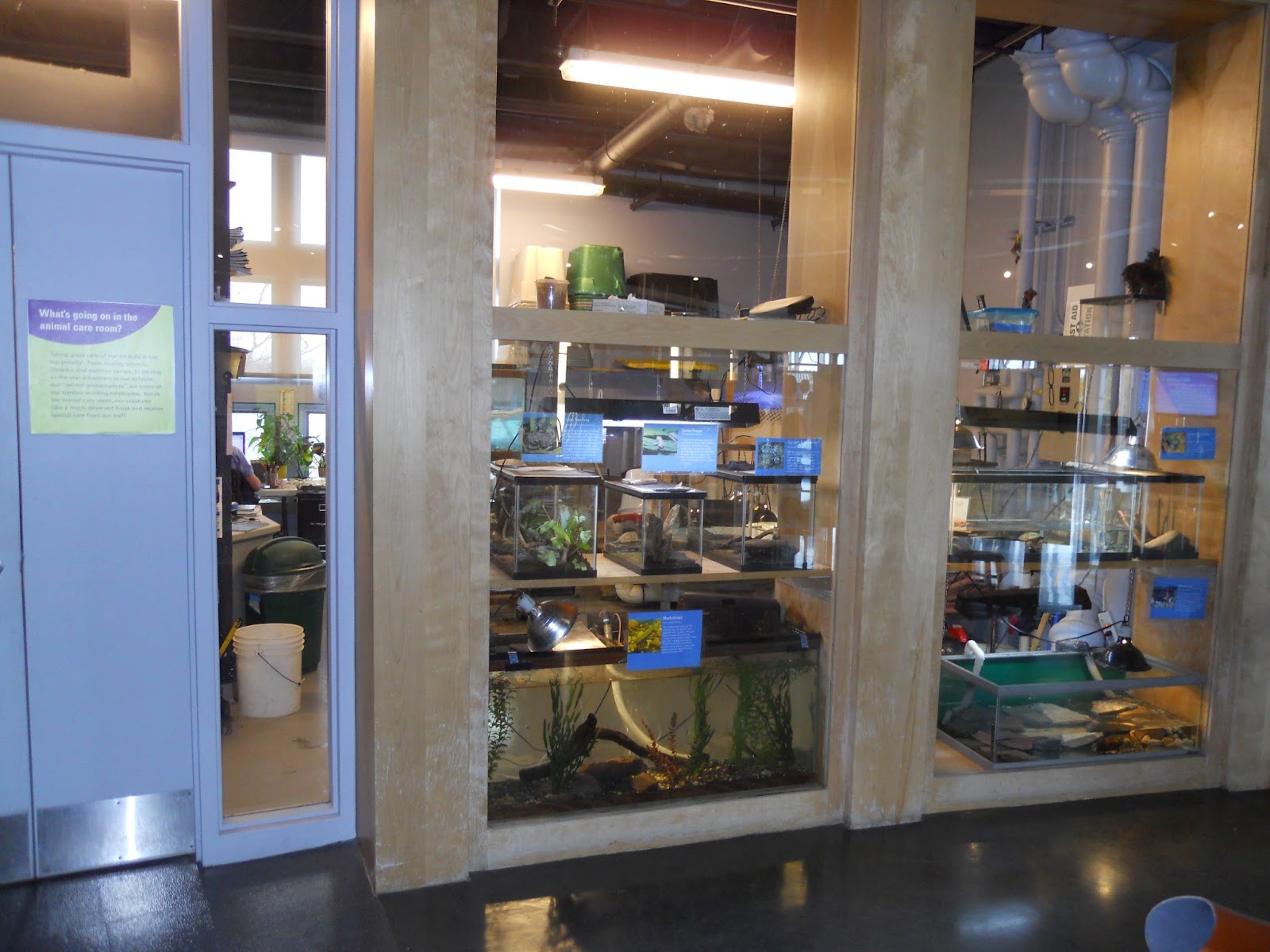
The ECHO Lake Aquarium is in Burlington, Vermont, right along the beautiful Lake Champlain waterfront. It does a lot of things very right. It takes some interesting risks in its exhibition - I'm going to try to write about the exhibition critique we did a the NEMA fall conference last year - but it generally holds with an open, crowd-friendly approach.
The animal care room was a neat example of that. Like all aquariums, ECHO has a large animal population that it rotates on and off view. I thought their solution to rotating animals off view was particularly nice, as well as their labeling of that space. Here's what it looked like.
 |
| If you can't read the photo, it says: "Taking good care of our animals is our top priority! From touring schools, libraries, and summer camps, to serving as the star attractions in our exhibits, our 'animal ambassadors' are some of our hardest working employees. Inside the animal care room, our creatures take a much-deserved break and receive special care from our staff. |
Friday, February 1, 2013
Museological Review from the University of Leicester
I realize I'm coming to this party very late, but this is terrific, and if you don't know about it, you should.
The University of Leicester has had a top-ranked museum studies program for quite some time, and they're the only degree program to my knowledge that offers a PhD in museum studies. I've been casually intrigued by the online PhD option they offer, but I'm not ready to commit to more graduate school yet, having been a free and independent soul for a whole nine months.
Since 1994, the program has published occasional issues of a peer-reviewed journal called Museological Review, and all past issues are up online. They've just published their first of 2013, full of some fascinating-looking articles from a recent conference on utopias.
I'll be reading through these issues over the next few weeks, and probably occasionally responding to them in this space. If you didn't know about this resource, enjoy!
(Because I'll use this place as an anchor point for any future reviews or talkbacks to articles, I'll continually update it with links to those articles.)
The University of Leicester has had a top-ranked museum studies program for quite some time, and they're the only degree program to my knowledge that offers a PhD in museum studies. I've been casually intrigued by the online PhD option they offer, but I'm not ready to commit to more graduate school yet, having been a free and independent soul for a whole nine months.
Since 1994, the program has published occasional issues of a peer-reviewed journal called Museological Review, and all past issues are up online. They've just published their first of 2013, full of some fascinating-looking articles from a recent conference on utopias.
I'll be reading through these issues over the next few weeks, and probably occasionally responding to them in this space. If you didn't know about this resource, enjoy!
(Because I'll use this place as an anchor point for any future reviews or talkbacks to articles, I'll continually update it with links to those articles.)
Subscribe to:
Comments (Atom)