Master Pieces: The Curator's Game
Thomas Hoving
I'll be honest: there's not much to this book, and it's only tangentially related to museums. It was a quick read, and for a non-art person it was amusing but not overly compelling.
The basic idea is that the first half of the book consists of detailed close-ups of various paintings in the history of Western art. Each close-up comes with a one or two sentence clue about its origins. Hoving calls this his version of the "curator's game" as they played it at the Metropolitan Museum of Art: trying to identify a painting or an artist by the tiniest sliver of the whole. (Incidentally, Malcom Gladwell mentions this game in his book Blink, calling it an example of "thin slicing" or how the human brain can make astonishing connections by being exposed to only the tip of the iceberg of something.)
Each painting is then reproduced at the end of the book with a short essay from Hoving's point of view about its place in art history. Once again, we are reminded that Hoving brought Velazquez's Juan de Pareja to the Met; the re-re-re-telling of that story takes up half of the essay about the Velazquez that's actually featured in the book. The essay about Uccello's painting is really mostly about how Hoving tried to assemble an exhibition of the tripartite work and everyone scoffed at him, but it would still be a great idea.
I did like the way it set about training my eye and getting me to really look at certain details in paintings. In that way, it was something of a book version of a good museum education program in front of a painting: notice the drapery through the wine glass, notice the orange hues of the window casement, notice the bunching of muscles on this nude.
Monday, February 18, 2013

Friday, February 15, 2013
Dorothy Parker and Wrong Words
I love to write, and have always been grateful that I am in a profession that allows me and encourages me to write, but oh, have I felt like this so many times.

Dorothy Parker's telegram to her editor. (Alas, found on Tumblr and so unsourced; if anyone has a source, please let me know so I can credit appropriately.)
Monday, February 11, 2013
Book Review: False Impressions: The Hunt for Big Time Art Fakes
False Impressions: The Hunt for Big Time Art Fakes
Thomas Hoving
This book is fairly typical of all Hoving's popular works, which is to say it's uncomfortably gossipy, breathtakingly arrogant, and compulsively readable.
The overall narrative of the book is split into two parts, and for me it didn't really get going until the second half. The first part is Hoving's chronological overview of art forgery through time, starting with Roman forgeries of Greek originals and coming up through the present day. The second part of the book is much more interesting, and follows Hoving himself through several major forgeries that he's unmasked (or tried to unmask) in museums throughout the world.
The first thing to understand about this book is that Hoving is never wrong, in anything. Even the fakes he purchased for the Met were ones that he felt uneasy about to begin with, and his gut was eventually proven correct. Disputes with other curators were of their own making, and they always loved him in the end. Eminent experts who fell for fakes are lesser, gullible, sad specimens. Oh, and in case you didn't know, he was responsible for bringing Velazquez's Juan de Pareja to the Met.
That overwhelming arrogance is particularly on play in this book, as part of his thesis on fakebusters (those who are particularly gifted at detecting forgeries) is that they have an innate sixth sense, a superior eye that allows them to instantly make judgments that ultimately, after further study, appear correct. Hoving himself, of course, has this eye.
In spite - or perhaps because of? - this personal heroism, this book is a great read. Hoving is a gifted storyteller, and he holds nothing back, giving you the constant impression of being let into his inner circle as he shares secrets, gossip, and information that would probably embarrass all sorts of people.
From a museology point of view, I was primarily struck by two things. First, Hoving has a very black and white view of what a "fake" is and he doesn't allow for much sophistication in thinking about the concept. For him, any work of art that is not 100% by the original artist is a fake. No in-the-style-of could possibly be as good as the original. He frequently recounts stories of art that has been so extensively restored that it is now worthless, and no longer original. He doesn't really allow for any further thinking about why someone might imitate a style, or what the line in over-restoring is, or what compels an art forger beyond money. Anyone who paints, sculpts, or otherwise makes art in a style not their own is committing a sin, full stop. Not really any moral gray areas or ambiguities there.
Second, and this one pained me quite a bit as the book went on: Hoving's concept of the museum begins and ends with expensive masterpieces. Money is nothing in the pursuit of a really good piece of art, and the millions spent on fakes by both himself, his curators, and the other museums he tells of are simply the price you pay in the collecting game. Education for him happens almost entirely through exhibitions that expose the masses to what they ought to know. The only time he talks about education "for the public" what he really means is an intensively scholarly weekend symposium that he put together on forgery - and by public, what he really means are rich collectors who might end up donating to the Met. Money is only to be used in pursuit of his particular version of perfection; woe to those who might want to use it to make school tours free, or expand art education in low income communities.
In the end, this was a highly entertaining read that frustrated me at times, but also made me think. It's a good weekend or beach read while still being "on topic" for museum professional development.
Friday, February 8, 2013
Animal Care Room at ECHO Lake Aquarium
I'm combing through some of my old photos of museum examples, and came across this space, which I remember loving.
The ECHO Lake Aquarium is in Burlington, Vermont, right along the beautiful Lake Champlain waterfront. It does a lot of things very right. It takes some interesting risks in its exhibition - I'm going to try to write about the exhibition critique we did a the NEMA fall conference last year - but it generally holds with an open, crowd-friendly approach.
The animal care room was a neat example of that. Like all aquariums, ECHO has a large animal population that it rotates on and off view. I thought their solution to rotating animals off view was particularly nice, as well as their labeling of that space. Here's what it looked like.
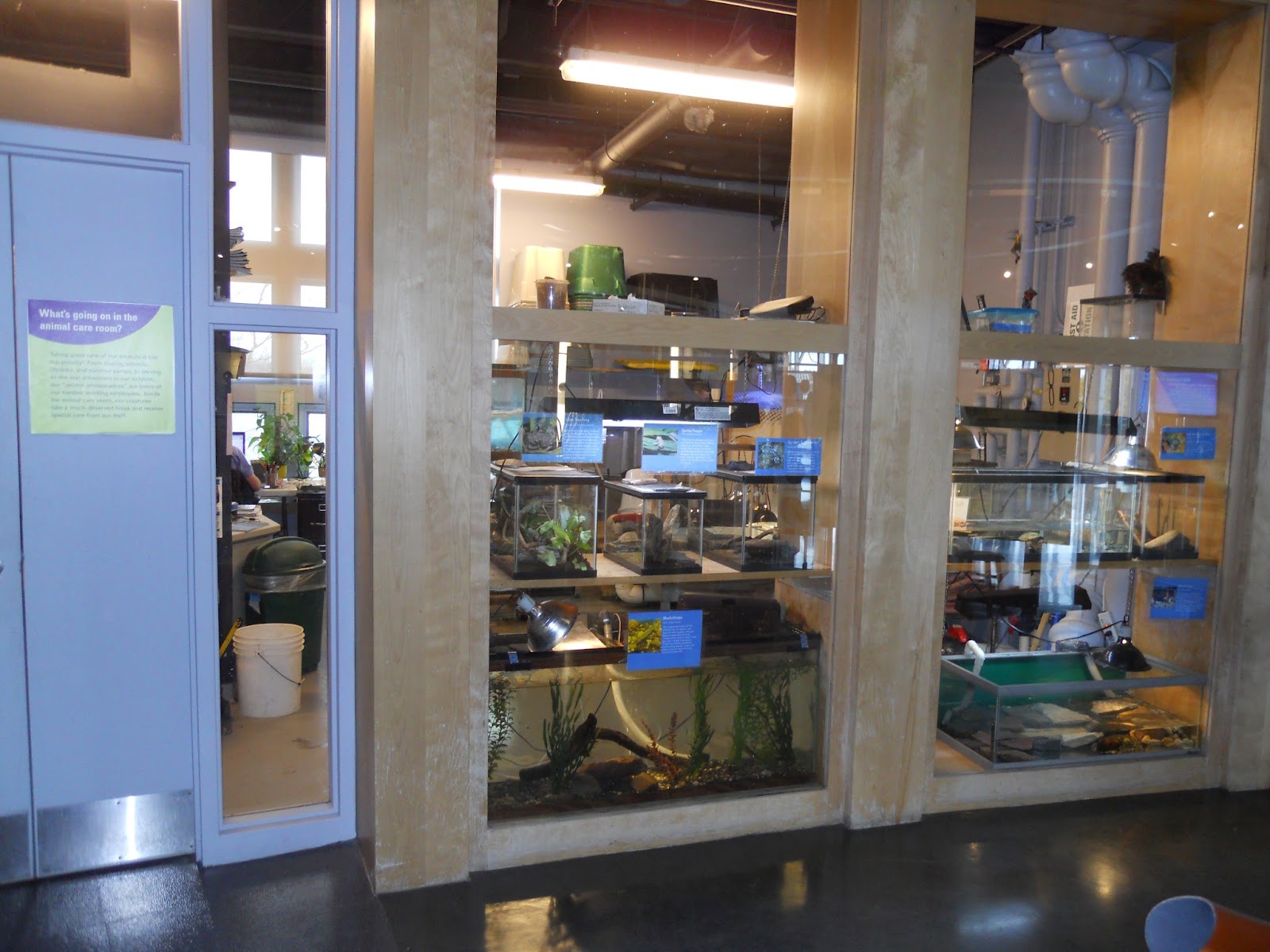
The ECHO Lake Aquarium is in Burlington, Vermont, right along the beautiful Lake Champlain waterfront. It does a lot of things very right. It takes some interesting risks in its exhibition - I'm going to try to write about the exhibition critique we did a the NEMA fall conference last year - but it generally holds with an open, crowd-friendly approach.
The animal care room was a neat example of that. Like all aquariums, ECHO has a large animal population that it rotates on and off view. I thought their solution to rotating animals off view was particularly nice, as well as their labeling of that space. Here's what it looked like.
 |
| If you can't read the photo, it says: "Taking good care of our animals is our top priority! From touring schools, libraries, and summer camps, to serving as the star attractions in our exhibits, our 'animal ambassadors' are some of our hardest working employees. Inside the animal care room, our creatures take a much-deserved break and receive special care from our staff. |
Friday, February 1, 2013
Museological Review from the University of Leicester
I realize I'm coming to this party very late, but this is terrific, and if you don't know about it, you should.
The University of Leicester has had a top-ranked museum studies program for quite some time, and they're the only degree program to my knowledge that offers a PhD in museum studies. I've been casually intrigued by the online PhD option they offer, but I'm not ready to commit to more graduate school yet, having been a free and independent soul for a whole nine months.
Since 1994, the program has published occasional issues of a peer-reviewed journal called Museological Review, and all past issues are up online. They've just published their first of 2013, full of some fascinating-looking articles from a recent conference on utopias.
I'll be reading through these issues over the next few weeks, and probably occasionally responding to them in this space. If you didn't know about this resource, enjoy!
(Because I'll use this place as an anchor point for any future reviews or talkbacks to articles, I'll continually update it with links to those articles.)
Wednesday, January 30, 2013
Book Review: The Convivial Museum
The Convivial Museum
Kathleen McLean and Wendy Pollock
I actually read this some time ago, but took extensive notes, so I'll work from them for this review. First, I would be remiss if I didn't mention that my copy came to me via a blog giveaway from Paul Orselli at his ExhibiTricks blog. His review of the book is here.
McLean and Pollock's book is a wonderful little overview of their theory of the "convivial" museum, which they consider an ideal form of museum that welcomes, makes its visitors comfortable, engenders trust, inspires action, and fosters relationships. It's an essentially social museum, in which the environment is designed to spark people off one another - and by that I don't necessarily mean the people in the room; the connection can be formed with the people behind objects and paintings, as well.
They repeatedly emphasize the physical environment of a museum, devoting sections to sound, light, space and other basic human comforts. I found their explorations of the ways in which these physical aspects can encourage and deter engagement to be thoughtful and well-done. The use of examples and photographs were also excellent and illustrative, helping to ground some of their more theoretical discussions.
I also appreciated their statement that "in the most convivial museums, a spirit of welcome starts at the top." Front line staff is and always will be crucial in shaping a visit, but to truly foster the atmosphere they're describing, welcoming behavior needs to be modeled at every level of the organizational chart.
I've been wondering if a more traditional book, with more cohesive and voluminous text might have fleshed out their ideas more - it's rare for there to be more than two or three sentences to a page, for example - but it might also have lost some of that sense of stating simple concepts and then demonstrating or illustrating them through museum examples. I remain torn. Ultimately, I think I'd love to have another, longer, more in depth book alongside this one in order to spend more time with these ideas.
Monday, January 28, 2013
10 Free or Low Cost Ways to Encourage Professional Development
Kristie Sheppard recently brought up the question of professional development for museums at AASLH's Small Museums Community blog: To Do or Not To Do: Professional Development.
I argued in the comments there that museums should always encourage professional development, that it should at least be partially paid for by the institution, and that it should be freely available to all staff, not dependent on seniority. I realize, however, that that's the ideal. What should museums who have few or no resources do to encourage learning among their staff? Here are ten ideas that are free or very low-cost.
1. Organize staff trips to other museums. Most museums have at least one day during which staff is scheduled but the doors are not open to the public. Why not take a few hours and have the whole staff meet at a nearby institution for some peer review? This can be done formally - including a meet'n'greet with the other staff members - or informally - everyone just shows up at the new exhibition and then talks about what they saw and what they thought over lunch.
2. Host a workshop, seminar, or exhibit critique. Many professional committees for regional and national museum associations are always looking for space to hold their events. Volunteer your space, and in return, bargain for a few seats in the seminar for your own staff. You can also invite the exhibits or programs committee of an association to one of your exhibits or programs and ask for a critique, which is a great learning experience all around.
3. Cross train. Sometimes professional development is as simple as adding new skills. Sit down with someone else who does a different job and ask them about it - maybe over lunch, maybe by shadowing them for a bit. Have a development person train to give school group tours. Have the director learn the cash register in the shop. Have the education person sit down with the registrar for a morning. Adding skills strengthens individual employees, deepens your own talent pool, gets people thinking out of the box, and increases camaraderie and understanding among staff.
4. Book clubs. There are so many brilliant books out there that offer great advice for museum professionals. Many of us read them in our spare time - I keep my own ongoing bibliography on this blog - but the benefits of having an institutionally-sponsored book club can be huge. Pick something that's general, or has good ideas, or even has nothing specifically to do with museums but espouses a particular ethos you want people to talk about. Encourage everyone to read that book over the course of a month, and meet together to discuss over lunch. This would work even better if staff could read a few pages at a time to clear their heads during work time.
5. MOOCs. This stands for "Massive Open Online Course," and it's a trend that's gaining speed right now. Websites like Coursera and MIT's OpenCourseWare offer college classes for free - all it takes is some time and commitment. It might take a little bit of searching to find something applicable to museums, but the payoff can be huge.
6. Free online certifications and webinars. There are a nearly infinite number of online certifications and webinars that are entirely free. FEMA has an entire online certification, complete with supporting classes, that is great for museum professionals. The Wild Apricot blog does a monthly roundup of free nonprofit webinars; here's their January 2013 listing. There are great resources at AASLH's Connecting to Collections website, including free courses. This is just the tip of the iceberg: spend a few minutes Googling and there's almost certain to be an online class that you'll be interested in. Are they always high quality? No. But they're free, and even in the worst of them you'll be presented with new ideas. For sensitive information - such as collections care - stick with reputable distributors.
7. In-house papers & presentations. Have your own mini-conference or lecture series! Set aside time every few months for staff members to present on a topic they're familiar with. If you want to have fun with it, try out some Pecha Kucha. Have the curator take an intriguing object out of the collections. Have a staff member who just got back from vacation talk about the heritage programs in another part of the country. Invite someone from a neighboring institution who just presented at a conference to repeat their presentation for your staff and thank them with dessert. Keep this fun, informal, and open so that no one feels intimidated.
8. Product demonstrations. Curious about that new exhibit case/archival box/software program? Want more training? Most companies will make a representative available for you to talk to. I've had great success at conferences walking up to product booths and being honest: "Your product is not in my area, and I don't have power over purchasing decisions, but I'm curious and I want to learn. Talk to me." Try the same thing over the phone; find out if someone will be in your area and try to connect. Great conversations and great learning happen.
9. Online conferences. These aren't usually free, but compared to the time and the cost of flying across the country and staying in a city for a week, they're a bargain. Here's the upcoming AASLH Annual Meeting's online registration; here's their page of previous sessions available for purchase. Here's AAM's roster of past annual meetings.
10. Socialize. Wait, what does this have to do with professional development? Trust me: on a basic level, many of the big professional development opportunities, like the AAM and AASLH national conferences, are about meeting people. You can encourage this even among your own staff. The better your staff knows and likes each other, the better they'll work together. We don't always have time to socialize with each other, and I might not know that you have the carpentry skills I desperately need to build the exhibit case I've always dreamed off. You can also enlarge this beyond just your organization: many professional organizations offer happy hours or cocktail meet'n'greets at local watering holes (#drinkingaboutmuseums comes immediately to mind, with branches in more and more cities); encourage everyone from your museum to attend.
Subscribe to:
Posts (Atom)